Laptops Are Getting More Expensive — and It's Only Going to Get Worse

If you've been waiting for laptop prices to drop before upgrading, the latest industry data suggests that window has closed — at least for now.
According to a TrendForce Q3 2026 cost analysis, three core components — the CPU, RAM, and SSD — now account for 68% of a mid-range laptop's total bill of materials. In Q1 2025, that figure was 45%. That 23-percentage-point jump in just 18 months has quietly gutted the budgets manufacturers use for everything else: screens, battery life, build quality, and chassis materials.
The memory squeeze
The spike traces back to DRAM contract prices, which surged 90–95% quarter-on-quarter in early 2026. The main culprit is supply diversion: chipmakers like SK Hynix are redirecting production capacity toward high-bandwidth memory (HBM) for AI servers, leaving standard DRAM for consumer devices in short supply. A 32GB DDR5 kit that cost around $70–90 a year ago now sells for well over $300 in European markets, with US pricing tracking a similar trajectory.
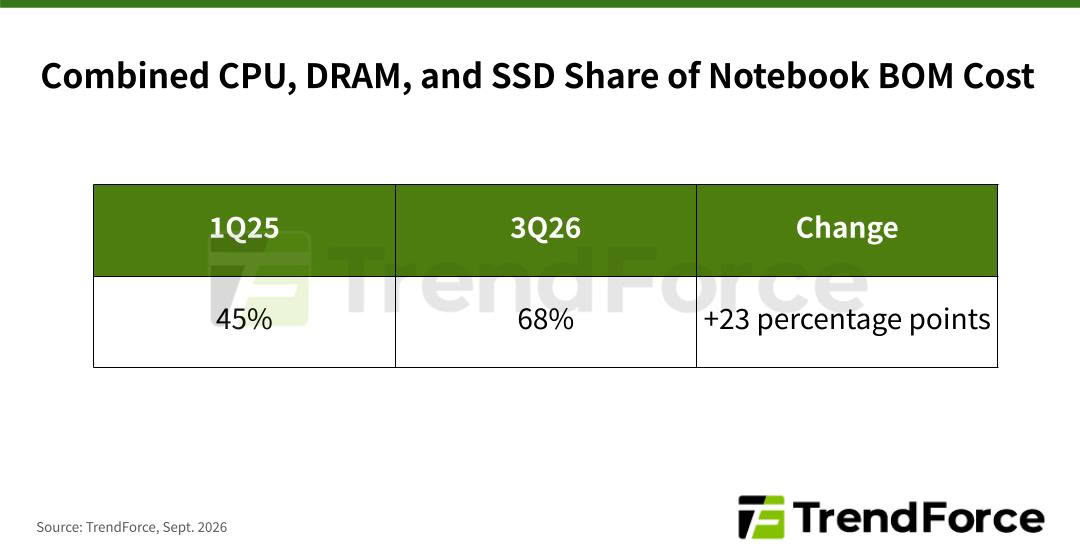
CPU, RAM, and SSD now make up 68% of a mid-range laptop's component cost — up from 45% in early 2025.
What this means at the checkout
To maintain the same profit margins as Q1 2025, brands would need to raise retail prices by around 80%, per the 80% price increase requirement analysis from eTeknix. A laptop that retailed for $900 would need to be priced at roughly $1,620 to hold the line on margins. Most brands won't go that far — instead, expect a mix of quiet spec downgrades and selective price hikes. Entry-level notebooks are already returning to 4GB of RAM in some markets, a regression that affects everyday tasks like running a browser with multiple tabs.
TrendForce forecasts global laptop shipments will fall 9.4% year-on-year in 2026 as higher prices suppress demand. Budget models are being squeezed hardest. Premium features like OLED displays are also slowing in adoption, as component costs leave little room for extras.
The supply chain gap
Not every brand is equally exposed. Apple's tightly integrated supply chain gives it more flexibility to absorb cost shocks than Dell, HP, or Lenovo, which rely more heavily on spot-market component pricing. As cheaper DRAM stockpiles from before the surge continue to deplete, those gaps between manufacturers will widen further.
For shoppers, the practical takeaway is straightforward: mid-range laptops bought today are likely better value than equivalent models six to twelve months from now.


